Your revenue cycle, from eligibility to remittance.
Autifis checks coverage, builds the superbill, scrubs the claim against the rules that actually deny chiropractic claims, submits it, and follows the money until it lands.
No card. No clearinghouse account needed to try it — the sandbox simulates the whole claim lifecycle.
Chiropractic claims get denied for chiropractic reasons.
Generic billing software does not know that Medicare wants AT on a spinal adjustment, that 97140 in the same region as the CMT is not separately billable at all, or that the 8-minute rule turns treatment minutes into billable units. So it lets the claim go out, and you find out six weeks later when the money does not arrive.
The denial you could have caught
A missing modifier is a rejection you pay for twice — once in the write-off, once in the hour it takes to rework it.
The money you stopped chasing
Denials age quietly. By the time a claim is 90 days old it is worth a fraction of its face value, and past timely filing it is worth nothing.
The visit you never billed
A superbill written up and never submitted is pure loss. Most software will not even tell you it is there.
Four steps, and the money lands.
- 01
Check coverage before the visit
Real-time eligibility (270/271) against the payer. Copay, coinsurance, deductible remaining and visit limits come back parsed — and are cached for the day so you are not burning calls.
- 02
Build the superbill
Pick the diagnoses, add the service lines. Quick-add for the codes you bill every day: CMT by region, exams, timed therapies with the minutes the 8-minute rule needs.
- 03
Scrub it before the payer sees it
Seventeen chiropractic rules run on every claim. Blocking errors stop it; warnings tell you what a payer is likely to argue with. You fix it in the room, not in six weeks.
- 04
Follow the money
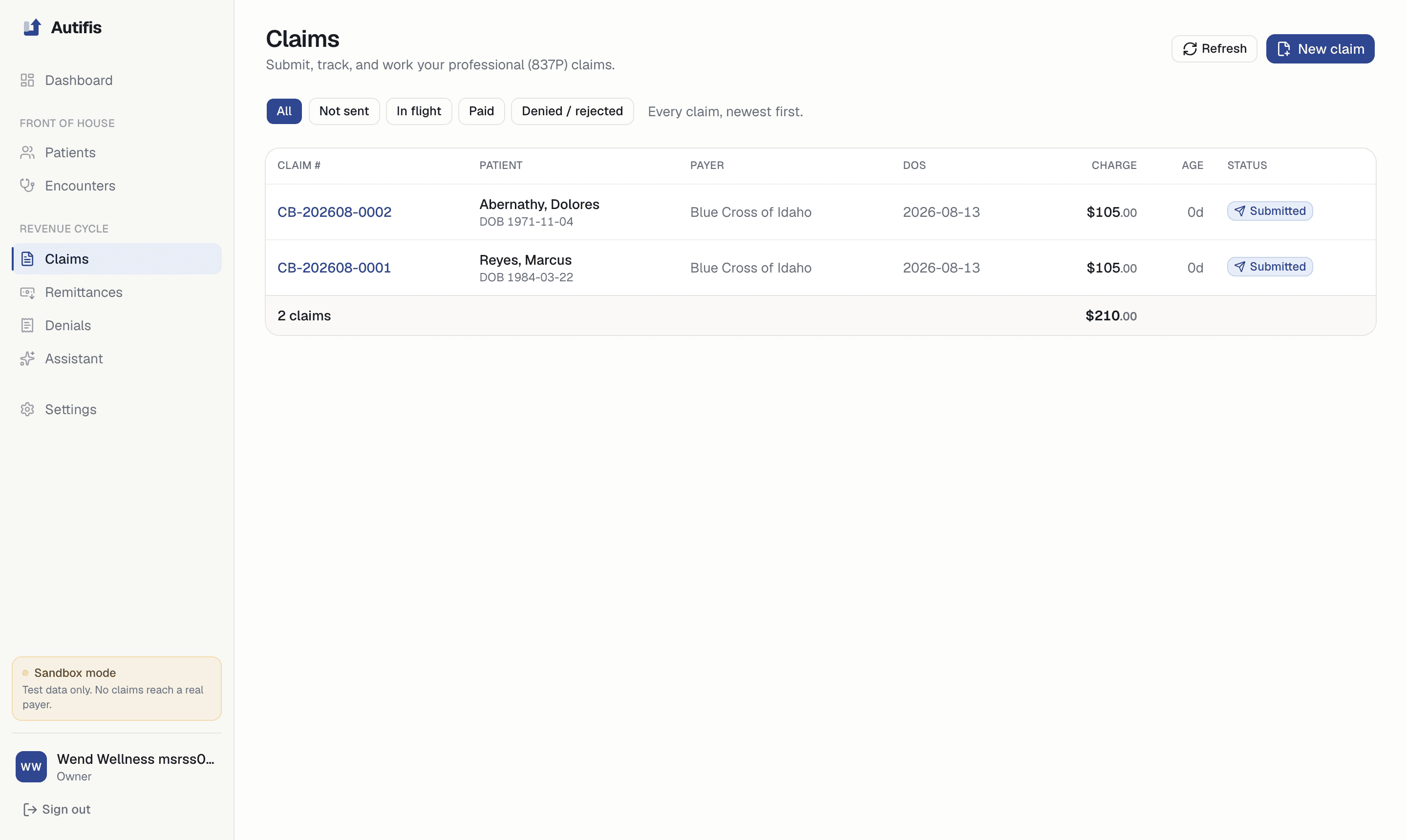
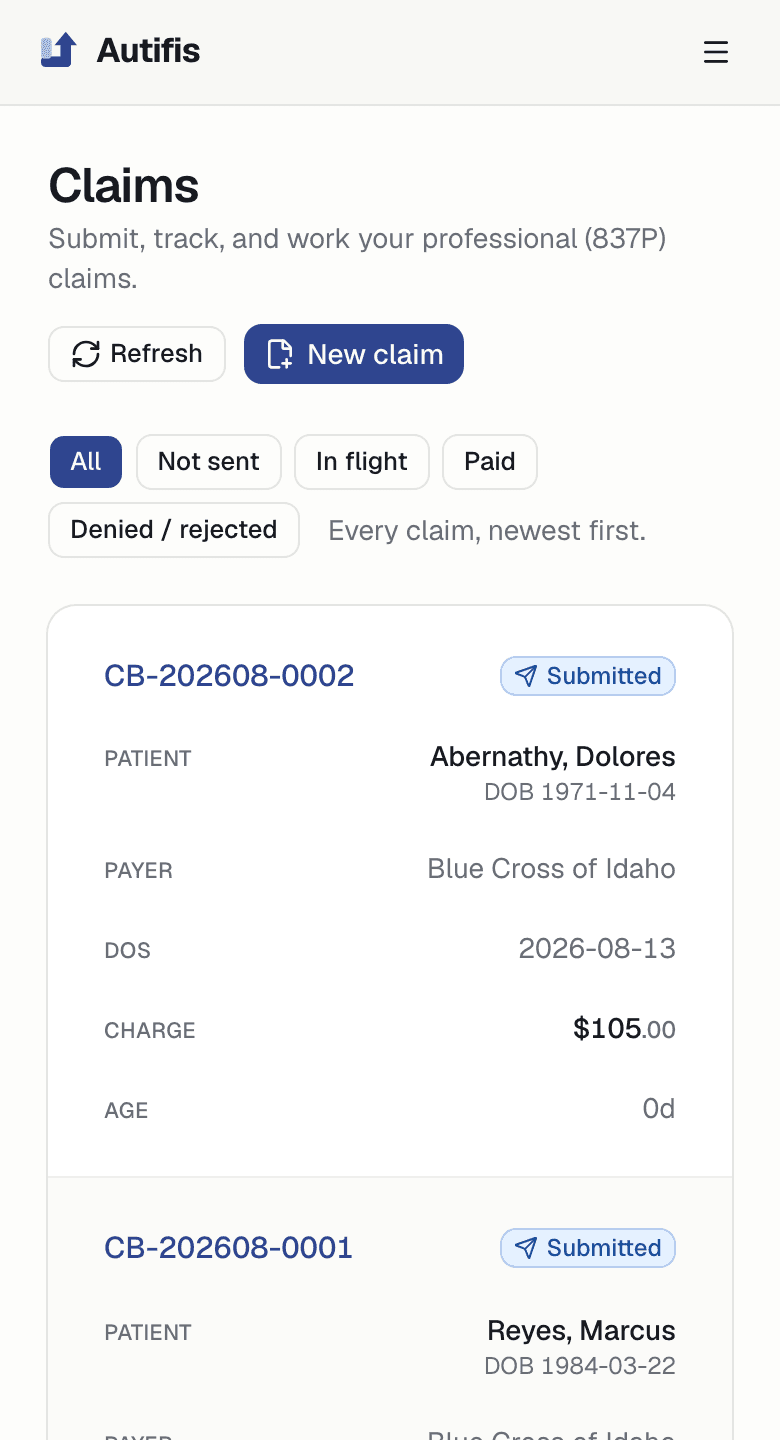
Statuses ingest automatically. Remittances post payments and adjustments with their CARC codes. What is denied lands in a worklist you can correct, appeal, or write off.
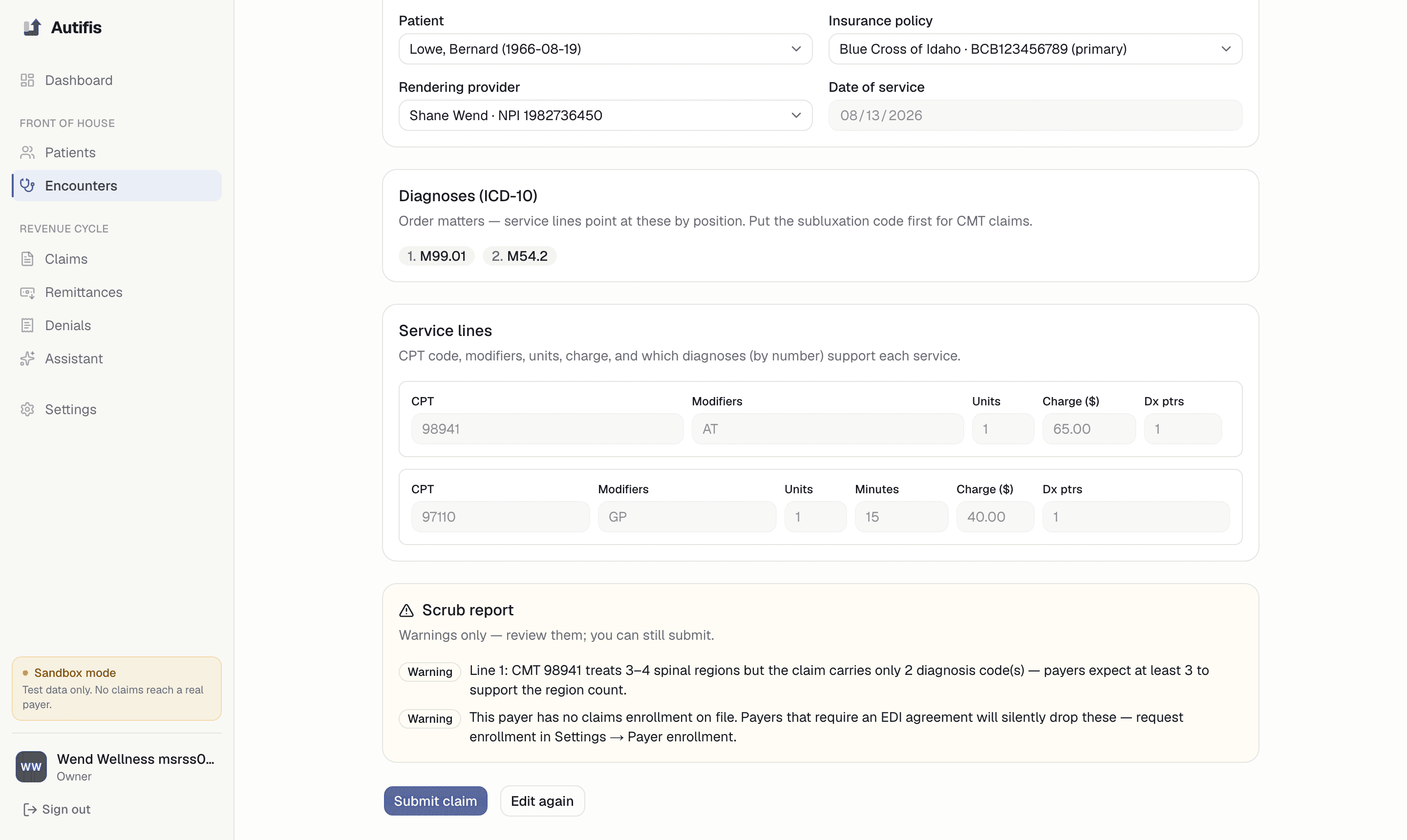
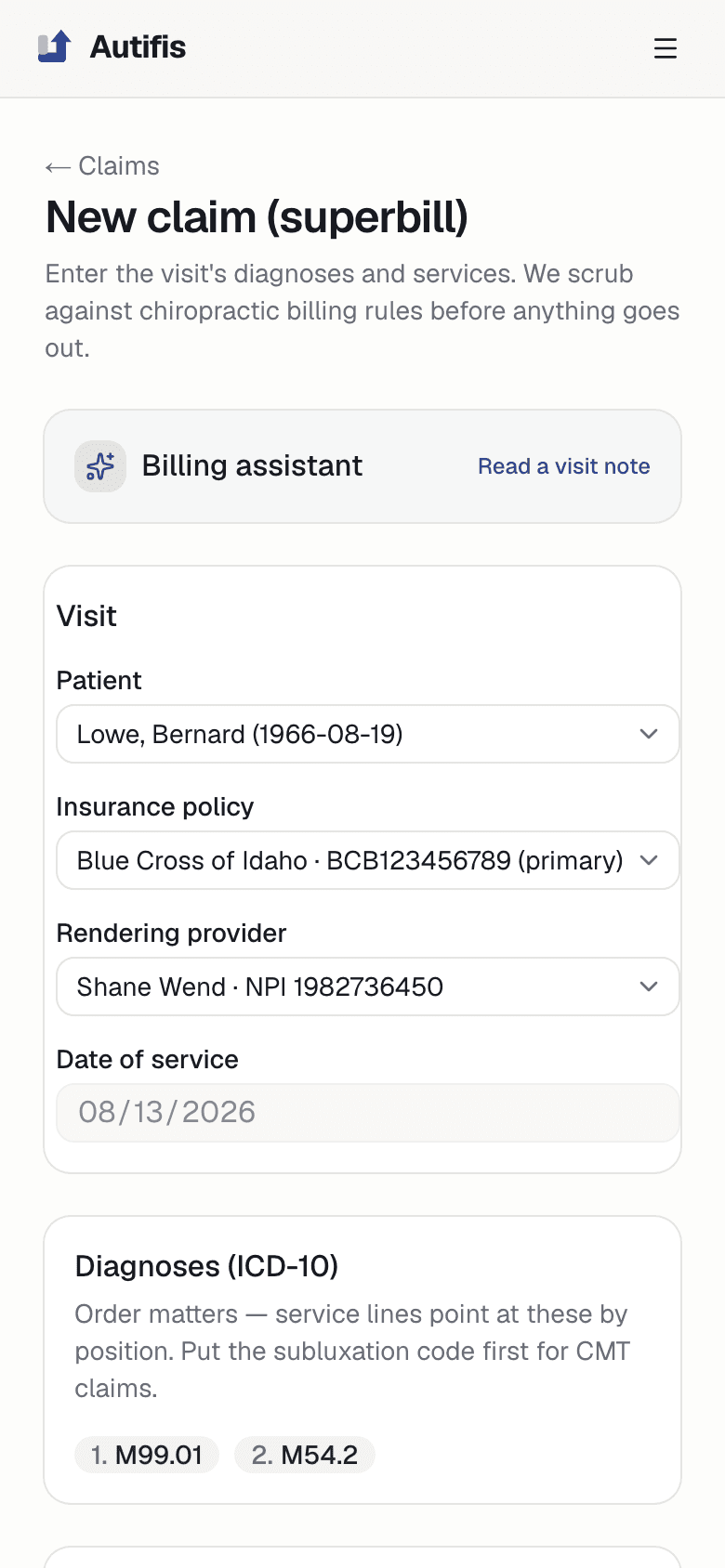
It knows what actually denies a chiropractic claim.
Every one of these runs on every claim, before it leaves the building. Blocking errors stop the claim. Warnings tell you what a payer is likely to argue with — and let you send it anyway, knowingly.
Medicare needs AT on spinal CMT, or it denies as maintenance care.
Billing maintenance care? GA when the ABN is signed, GZ when it is not.
97140 in the same spinal region as CMT is not separately billable — a distinct-service modifier applies only to a different, documented region, never as a way to unbundle same-region therapy.
Timed therapy units must be supported by the minutes actually rendered. Overbilling blocks; under-billing warns.
An E/M on the same day as an adjustment needs 25, or it gets bundled.
Medicare covers only spinal CMT from a chiropractor. Everything else is statutorily excluded.
Subluxation primary, with enough diagnoses to support the region count you are claiming.
A dependent claim carries the subscriber's demographics, or the payer rejects it.
The whole revenue cycle, not a piece of it.
A scrubber that knows chiropractic
Not a generic claim validator. Payer-aware rules for Medicare, Medicaid and commercial plans — blocking what will be denied and flagging what will be argued with.
AR that ages in front of you
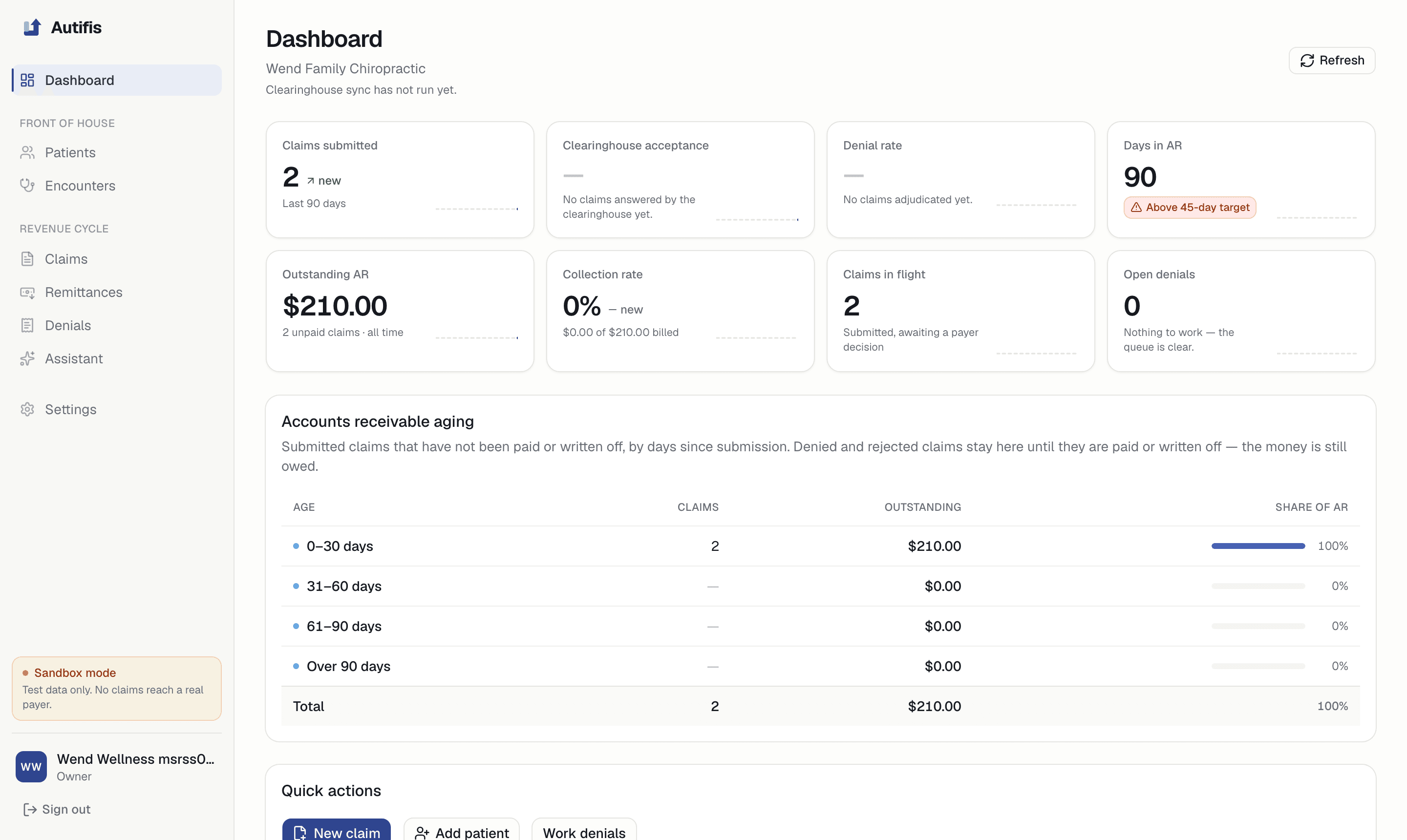
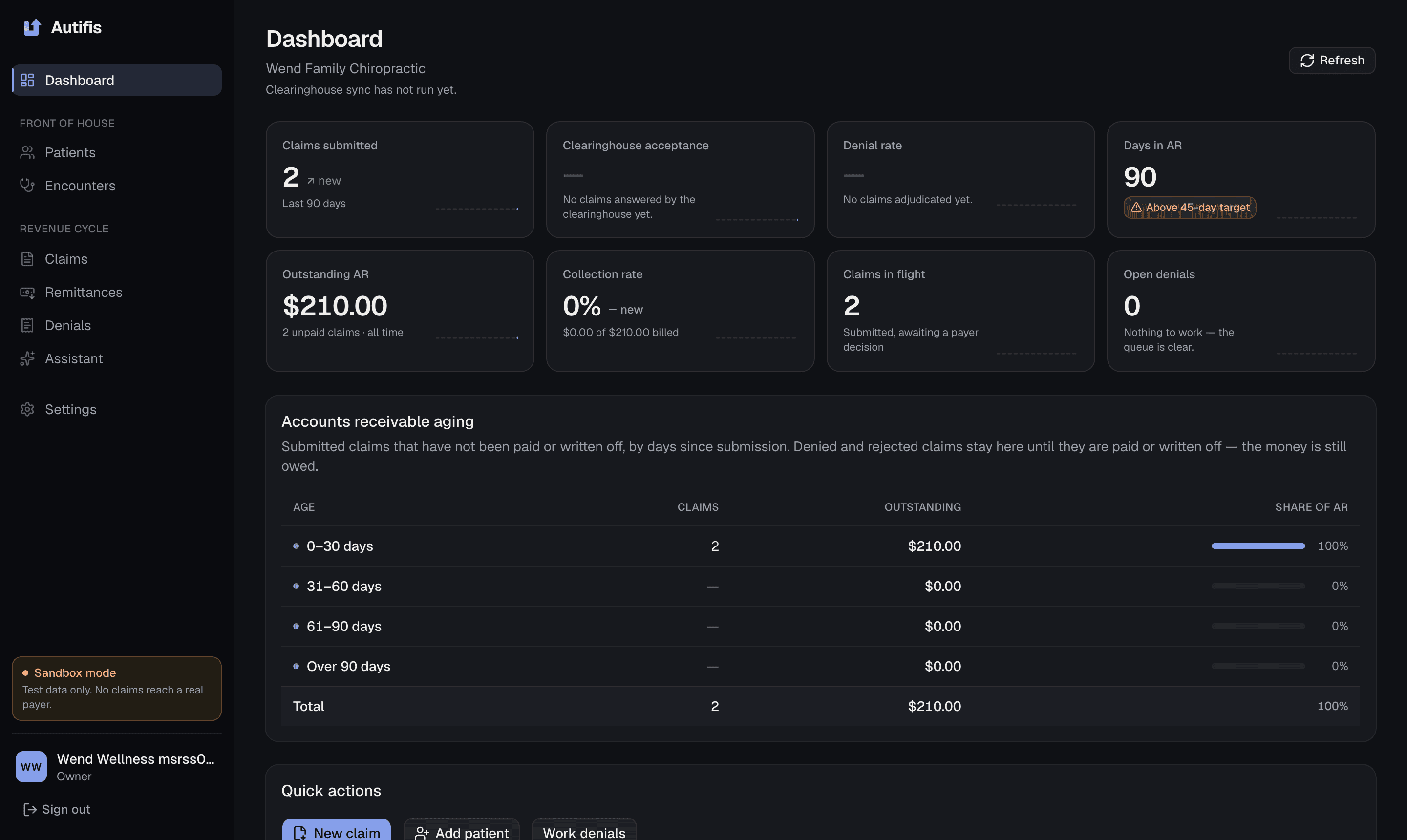
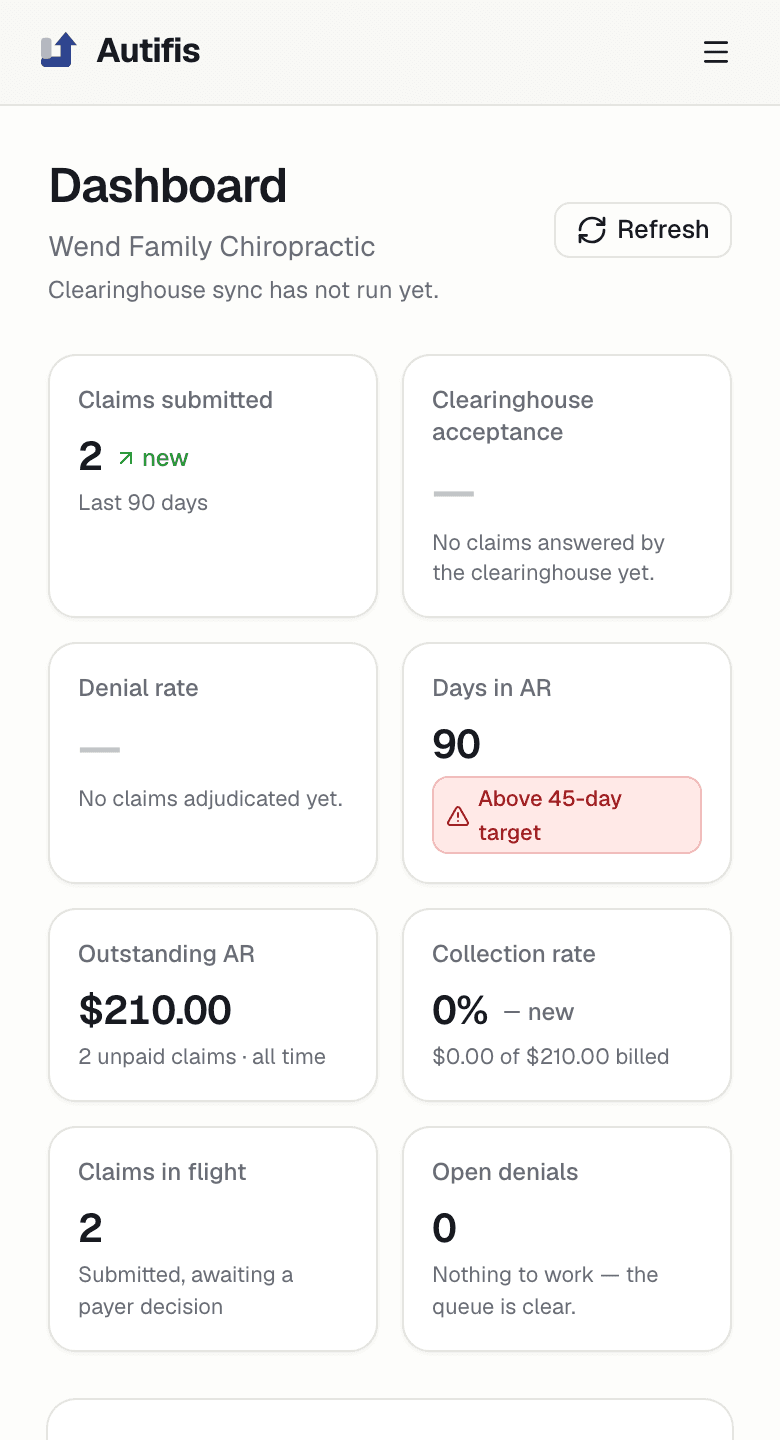
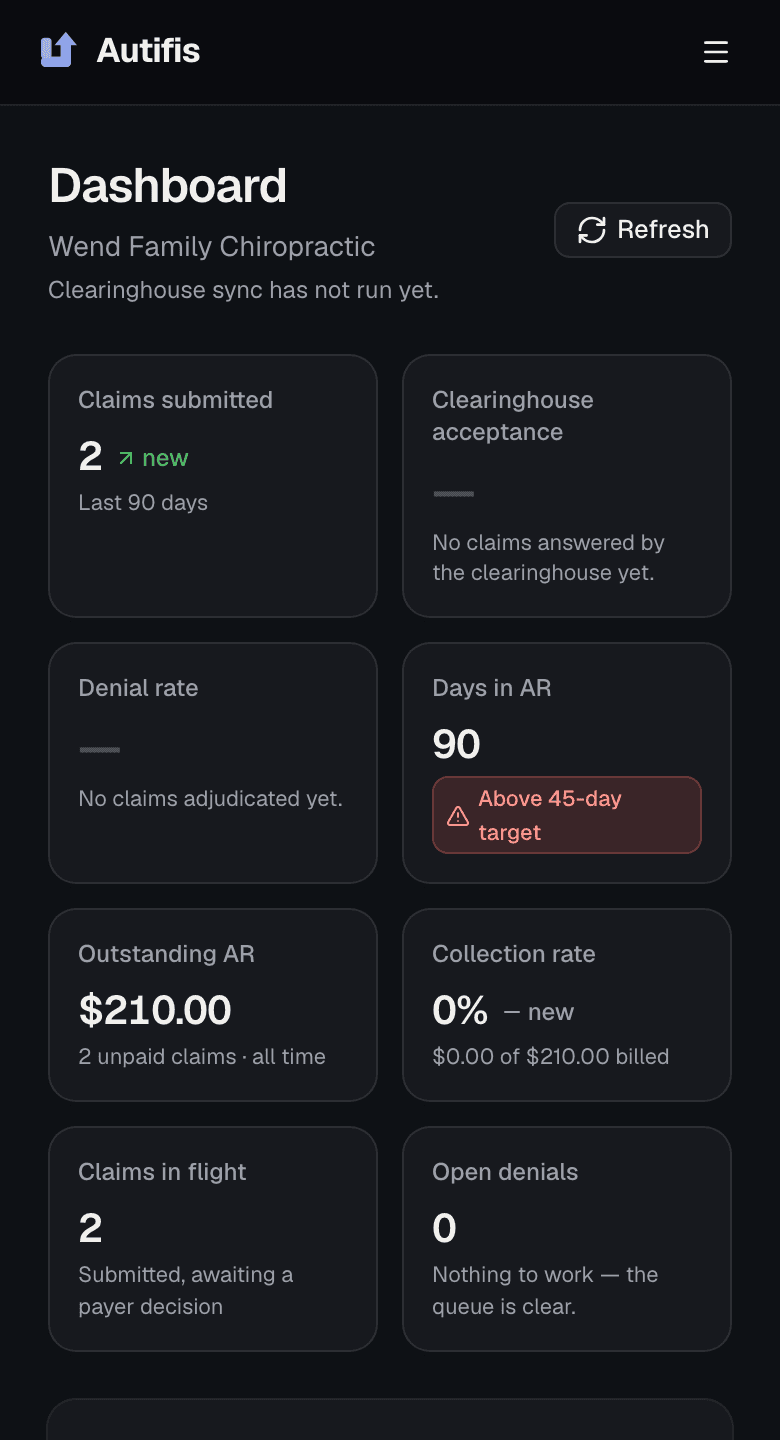
Days in AR against the 45-day benchmark, aging buckets, and a denials worklist. Old money is coloured like old money.
Denials you can actually work
Correct and resubmit as a true replacement claim (frequency 7, with the payer's own claim number). Appeal it. Or write it off — deliberately, and on the record.
Remittances that post themselves
835s pull in, payments and CARC/RARC adjustments post against the claim, patient responsibility splits out, and the raw 835 is kept for audit.
Bring your own keys
Your Claim.MD account, your payer relationships, your data. The key is envelope-encrypted at rest and decrypted only for the call itself.
A team, with real roles
Owner, admin, biller, read-only. Invite a teammate; revoke them and the session dies within a minute, not at their next sign-in.
Built for PHI from the first commit.
Not a compliance sticker added at the end. These are the controls the product actually ships with — and the ones it deliberately has not claimed yet.
- Tenant isolation enforced by Postgres row-level security — a bug in the app cannot cross tenants
- Clearinghouse keys and tax IDs envelope-encrypted (AES-256-GCM), never logged, never sent to the browser
- Append-only audit trail, enforced in the database and free of PHI by construction
- PHI redaction in structured logs and in error reporting
- A hard compliance gate: no real patient data until the BAAs are signed
- Signed BAAs with every subprocessor that touches PHI
- An independent security review before the first live practice
Until those are done the product refuses real patient data outright — there is a hard flag in the code, and it is on.
Priced per practice, not per claim.
Your clearinghouse account is your own. We do not take a cut of what you collect.
Pricing is not final. These tiers are a starting point for the pilot.
Solo
One chiropractor, one location.
- Unlimited claims
- Eligibility checks
- Chiropractic scrubber
- Denials + AR worklists
- Bring your own Claim.MD key
Practice
Multiple providers, one practice.
- Everything in Solo
- Unlimited providers
- Team roles + invitations
- Service locations
- Payer enrollment tracking
- Priority support
Billing company
Several practices under one roof.
- Everything in Practice
- Multiple practices, isolated
- Per-practice clearinghouse keys
- Consolidated AR reporting
- Onboarding support
Questions a biller actually asks.
Do I need a Claim.MD account to try it?
No. The sandbox simulates the entire claim lifecycle — submission, clearinghouse acknowledgement, payer adjudication, remittance — so you can run a claim end to end before you connect anything. When you are ready, you paste your own Claim.MD account key.
Is it HIPAA compliant?
It is HIPAA-ready by design, and we will not claim more than that. The controls are built: tenant isolation in the database, encryption at rest for keys and tax IDs, a PHI-free append-only audit trail. What is not done is the paperwork — the BAAs with each subprocessor. Until those are signed the product refuses to accept real patient data at all: there is a hard flag, and it is on.
What happens to my data if I leave?
You can export it and we can delete it. There is a real deletion path, not just a soft-delete flag — though note that medical billing records typically carry a 6–7 year retention obligation, so deleting them may not be something you actually want to do.
Does it replace my EHR?
No. It is the revenue cycle — eligibility, claims, remittances, denials, AR. Clinical charting stays where it is. It is deliberately a narrow, well-understood surface: chiropractic billing, done properly.
Why chiropractic only?
Because the rules that get chiropractic claims denied are specific — AT modifiers, NCCI bundling of manual therapy into CMT, the 8-minute rule, Medicare's statutory exclusions. A generic scrubber does not encode any of that. A narrow product can.
Can two people use it at once?
Yes. Owner, admin, biller and read-only roles, with invitations. Permissions are enforced on the server for every action, not just hidden in the UI.
Run a claim end to end in the next ten minutes.
The sandbox simulates the whole lifecycle — submission, clearinghouse acknowledgement, payer adjudication, remittance. No clearinghouse account, no card, no real patient data.